
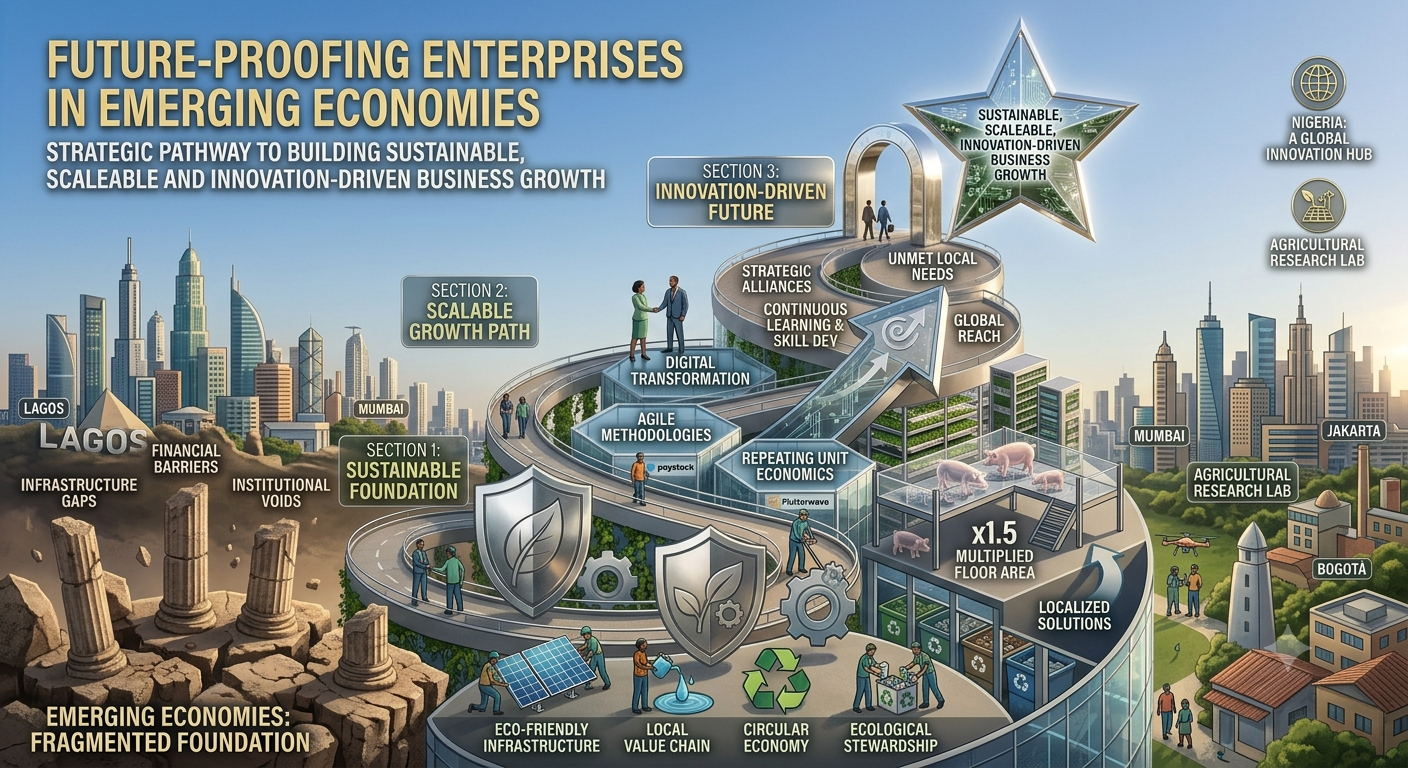
FUTURE-PROOFING ENTERPRISES IN EMERGING ECONOMIES: STRATEGIC PATHWAY TO BUILDING SUSTAINABLE, SCALEABLE AND INNOVATION-DRIVEN BUSINESS GROWTH

BY
ANGELA KELECHI IBEAKO
07039338364
ABSTRACT
Enterprises in emerging economies such as Nigeria face a dual reality: immense growth potential alongside systemic barriers including infrastructural deficits, policy inconsistency, and socio-political volatility. This paper critically examines how businesses in such contexts can “future-proof” themselves by embedding sustainability, scalability, and innovation into their strategic core. Drawing on global theories of competitive advantage, innovation, and sustainability, the study evaluates their applicability in volatile markets and highlights necessary adaptations. Case studies of MTN Nigeria, Flutterwave, Dangote Group, Reliance Jio, and Zipline illustrate how visionary leadership, frugal innovation, and ESG integration can transform constraints into competitive advantage.
The research introduces the AKI GLOBAL Future-Proofing Framework, which integrates seven core values—Trust, Excellence, Education, Integrity, Innovation, Service, and Sustainability—into a blueprint for enterprise resilience. Findings suggest that enterprises can overcome structural barriers by leveraging technology, diversifying financing, investing in human capital, and adopting governance practices that build credibility. The study concludes that future-proofing is not merely a survival strategy but a pathway to global relevance and inclusive socio-economic transformation. By bridging theoretical models with contextual realities, this work contributes to academic discourse while offering actionable insights for entrepreneurs, policymakers, and investors seeking to build sustainable and innovation-driven enterprises in emerging economies.
Keywords: Future-proofing, emerging economies, Nigeria, sustainability, scalability, innovation, competitive advantage, ESG, leadership, enterprise resilience.
Download Journal Here!