
A COMPARATIVE APPRAISAL OF CRIMINAL PROCEEDINGS IN NIGERIA: CHALLENGES AND REFORM PROSPECTS

BY
UDENSI JONAS OKORIE
Abstract
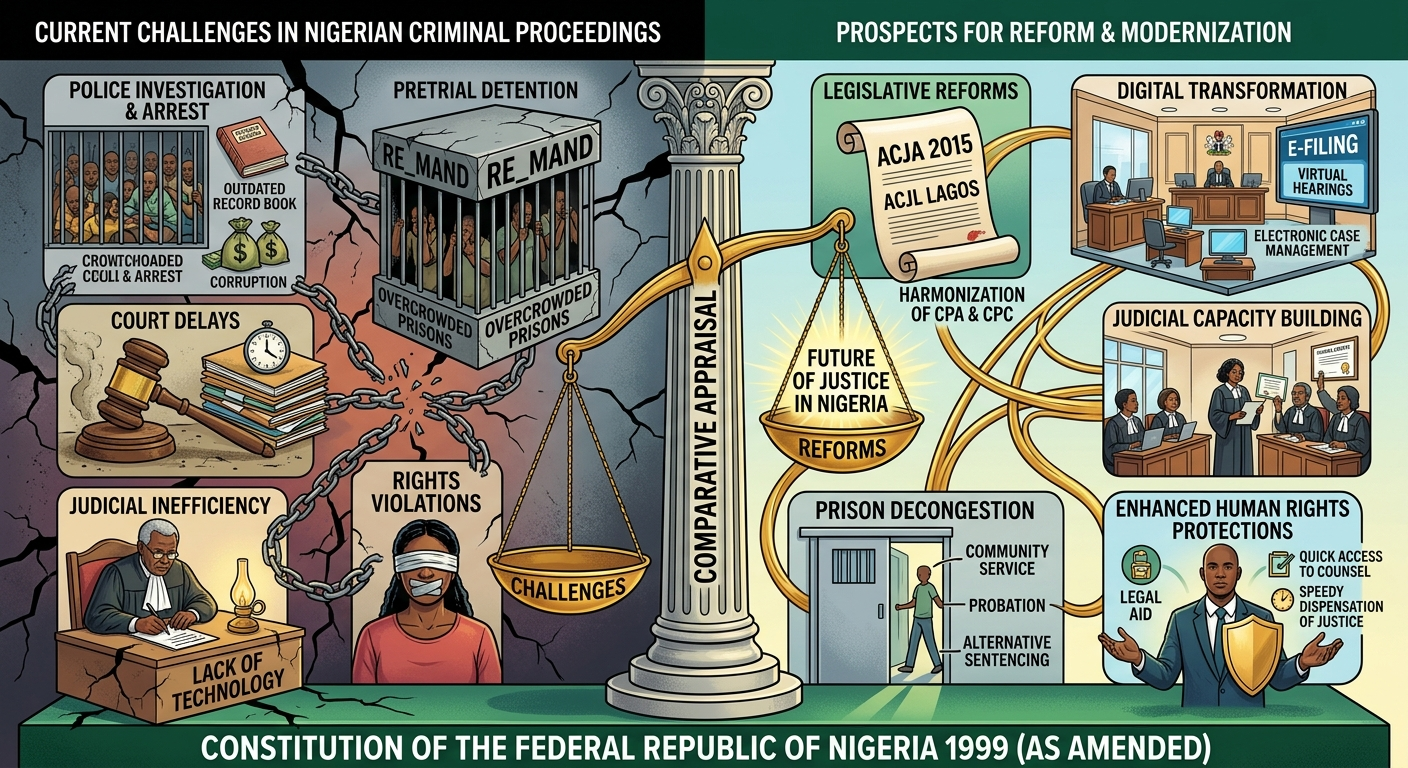
This study offers a comparative analysis of criminal proceedings in Nigeria, examining their historical development, structural framework, and procedural dynamics. It highlights persistent challenges, including trial delays, weak enforcement of statutory provisions, prosecutorial lapses, overcrowded correctional facilities, and executive interference that undermines judicial independence. Anchored on a qualitative doctrinal methodology, the research draws upon statutory instruments, judicial authorities, policy documents, and scholarly literature to evaluate the extent to which Nigeria’s criminal justice system aligns with international standards of fairness, efficiency, and human rights protection. Comparative insights are drawn from jurisdictions including the United States, United Kingdom, South Africa, India, and Canada, where reforms such as plea bargaining, digital case management, witness protection, judicial activism, and restorative justice have improved justice delivery.
Findings reveal that despite legislative interventions such as the Administration of Criminal Justice Act (ACJA) 2015, systemic inefficiencies and poor enforcement continue to impede substantive justice. The study argues that meaningful reform requires institutional restructuring, enhanced judicial capacity, adoption of restorative and technology driven justice frameworks, and sustained political commitment to the rule of law. By situating Nigeria’s challenges within a comparative framework, the research contributes to the ongoing discourse on criminal justice reform and proposes pragmatic, contextually adaptable strategies for strengthening criminal proceedings in Nigeria.
Keywords: Criminal proceedings, Nigeria, Administration of Criminal Justice Act (ACJA), judicial independence, restorative justice, comparative legal analysis, criminal justice reform, human rights protection.
Download this journal here!