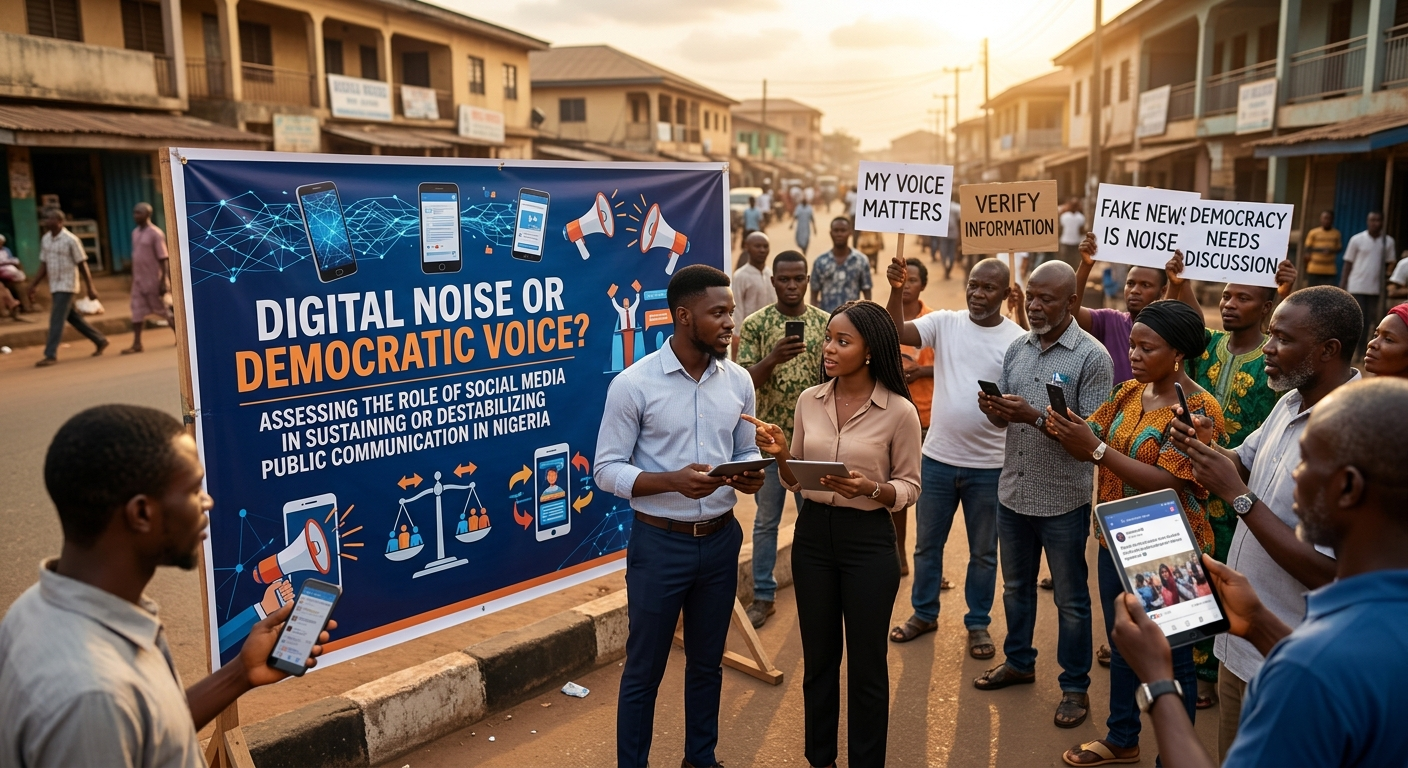
Digital Noise or Democratic Voice? “Assessing the Role of Social Media in Sustaining or Destabilizing Public Communication in Nigeria”

By
Peter Nweke
School of Communication and Media Studies LLBSUK
PGD Cohort 2
Abstract:
This study interrogates the dual role of social media in Nigeria’s public sphere, asking whether it functions as a “Democratic Voice” that sustains civic engagement or as “Digital Noise” that destabilizes communication. Using a descriptive survey design with 152 respondents, supported by reliability testing (Cronbach’s α > 0.70), the research examined sustaining contributions, destabilizing effects, and public preferences for regulation. Findings reveal a paradox: while social media improves access to information (Mean = 4.13) and encourages citizen engagement (Mean = 4.01), its destabilizing impact is statistically stronger (p = .009). The most critical threat identified is the spread of unverified information causing public panic (Mean = 4.17), surpassing concerns about hate speech or propaganda. Regression analysis further shows that exposure to fake news does not significantly predict demand for regulation (p = .087). Instead, belief in digital literacy emerges as the strongest predictor (p = .006), indicating that Nigerians favor empowerment and education over censorship. Qualitative insights reinforce this preference, with respondents overwhelmingly endorsing individual verification and digital literacy as solutions. The study concludes that while social media remains indispensable for democratic participation, its current ecosystem is weighted toward disruption. Sustainable resolution lies in institutionalized digital literacy, individual responsibility, and verification protocols, rather than coercive state control. These findings carry critical implications for policymakers, civil society, and communication scholars seeking to balance the risks and benefits of digital platforms in Nigeria’s evolving public sphere.
Keywords: Social media; Public communication; Democratic voice; Digital noise; Nigeria; Misinformation; Digital literacy
Download this journal here!