

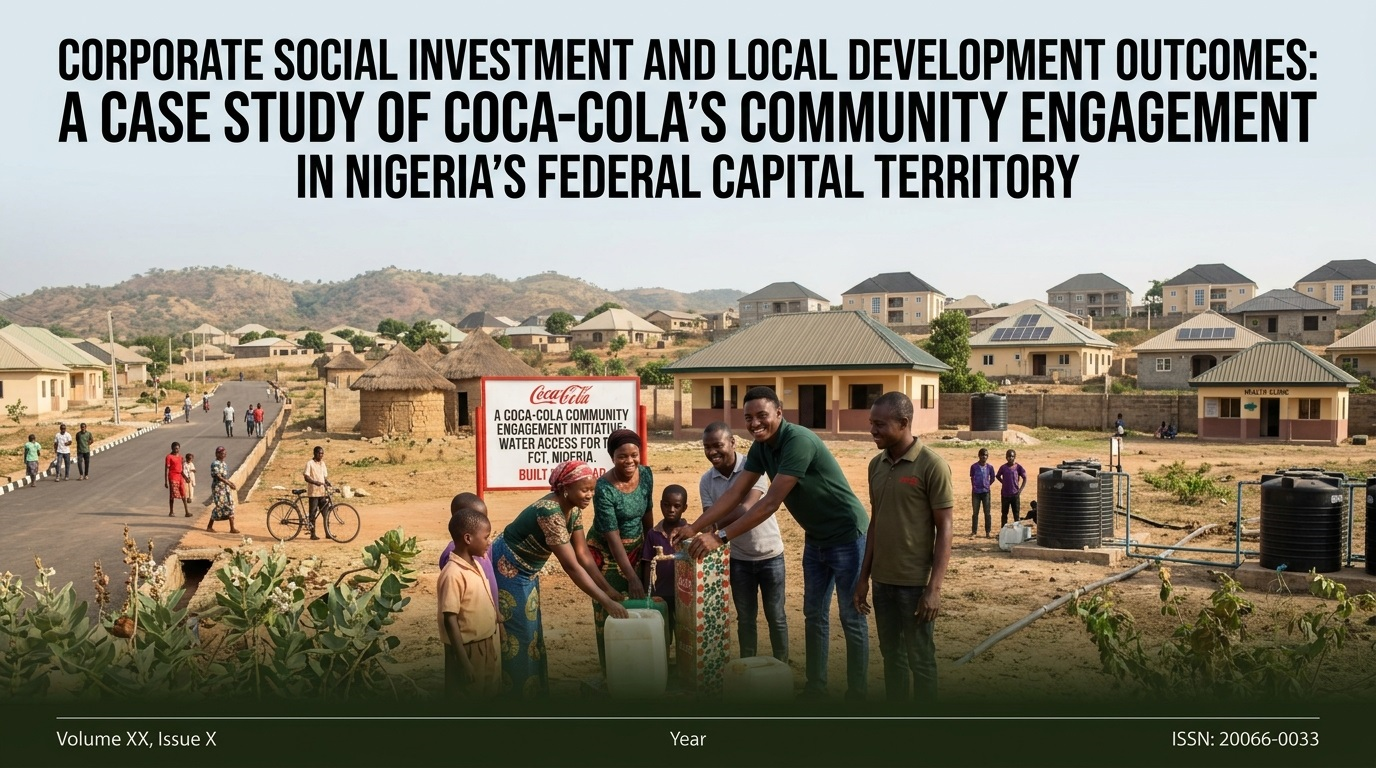
CORPORATE SOCIAL INVESTMENT AND LOCAL DEVELOPMENT OUTCOMES: A CASE STUDY OF COCA-COLA’S COMMUNITY ENGAGEMENT IN NIGERIA’S FEDERAL CAPITAL TERRITORY

BY
GLORIA IKIBAH
AND
DR. SAMMY ADRIAN AJUFO
ABSTRACT
This study explores the potential of Corporate Social Investment as a strategic approach that not only addresses community development outcomes but also enhances competitive advantage. By examining Coca-Cola’s community engagement initiatives in selected Area Councils of Nigeria’s Federal Capital Territory, Abuja, it highlights the concept of mutual value creation where Corporate Social Investment creates simultaneous benefits for the corporation and the communities they engage.
For decades, multinational companies have increasingly used Corporate Social Investment CSI as a strategic component of their operations in emerging economies, often making this initiative of mutual benefit for the sustainability of business and host communities.
Despite the importance of these programmes, verifiable evidence on their visible contributions to the community’s socio-economic development remains limited and most often informal.
While some stakeholders view Coca-Cola’s engagement as a genuine contribution to social progress, others see these initiatives as brand-led exercises with limited structural significance.
This research bridges this gap by critically assessing the scope, design, and perceived impact of Coca-Cola’s CSI activities in the FCT, with a particular focus on access to water, youth empowerment, education support, and environmental stewardship. In doing so, the study aims to prioritize these dimensions by closely analyzing which single outcome most effectively embodies the potential for community development. Access to water is posited as the central theme, given its immediate impact and sustainability challenges, and is followed by evaluations of youth empowerment, education support, and environmental stewardship. Ranking these aspects provides a clear evaluative focus, streamlining subsequent discussions.
A qualitative case study was adopted, drawing on a combination of semi-structured interviews with members of the community, traditional leaders, and project managers, as well as analysing documents of company reports, project briefs, and independent evaluation reports.
To maximise developmental impact, the research recommends a shift towards participatory planning models, stronger collaboration with public sector agencies, and adoption of independent impact assessment processing.
The study concluded that CSI can contribute meaningfully to local development when projects are co-designed with beneficiary communities, embedded within the existing institutional system, and supported by mechanisms for accountability and capacity building.
The research recommends a shift towards participatory planning models, strong collaboration with public sector agencies, and adoption of impact assessment processes that are independent.
Keywords: Corporate Social Investment, Local Development, Community Engagement, Coca-Cola, Nigeria, Stakeholder Theory, Sustainable Livelihoods.
Download Journal Here!