
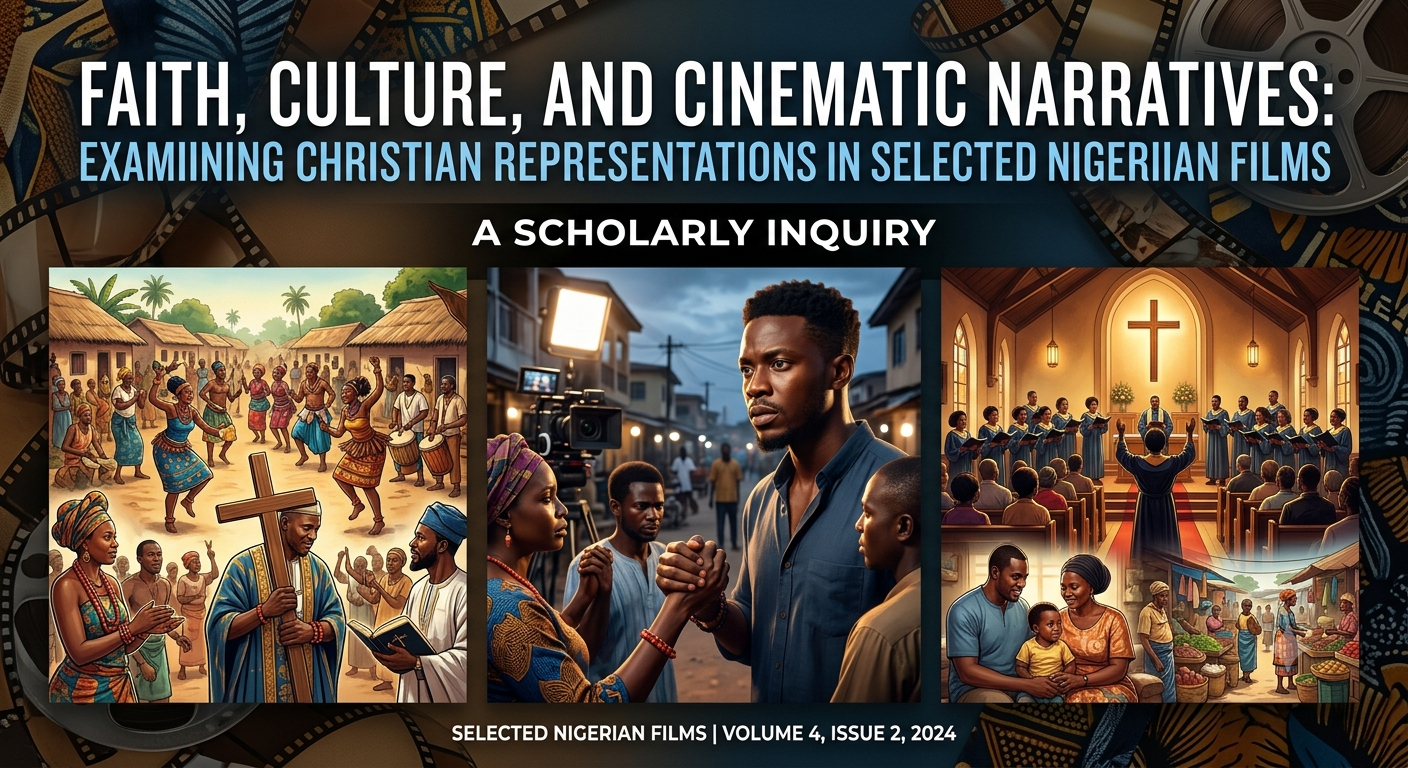
FAITH, CULTURE, AND CINEMATIC NARRATIVES: EXAMINING CHRISTIAN REPRESENTATIONS IN SELECTED NIGERIAN FILMS

BY
EBENEZER ALEXANDER IKECHUKWU
08030609053
ABSTRACT
The increasing incorporation of religious themes in Nigerian cinema has generated scholarly interest in how Christianity is represented and interpreted within Nollywood productions. While many films employ Christian symbols, language, and narratives, concerns have emerged regarding the extent to which such representations align with or diverge from traditional Christian teachings. This study critically examined the portrayal of Christian themes in two contemporary Nigerian films, Breath of Life and A Tribe Called Judah, with particular attention to what the study describes as the “pseudo-gospel” phenomenon in Nollywood. Drawing on Cultural Studies Theory, the research explored how religious imagery and narratives are utilized to communicate moral, social, and cultural messages within popular cinema.
The study adopted a qualitative content analysis approach. Selected scenes, dialogues, characters, and narrative elements from the two films were systematically coded, categorized, and analyzed to identify recurring themes relating to faith, redemption, morality, salvation, and Christian identity. Findings revealed that both films employ Christian language, symbolism, and references that create expectations of faith-based storytelling; however, several narrative elements were found to emphasize secular values, moral ambiguity, and character behaviors that appear inconsistent with traditional Christian doctrines. The analysis further showed that religious motifs were often used as cultural and narrative devices rather than as vehicles for explicit theological instruction.
The study concludes that the representation of Christianity in contemporary Nollywood reflects an evolving interaction between faith, culture, and entertainment. It recommends greater collaboration between filmmakers, theologians, and religious scholars to promote theological accuracy while preserving artistic creativity and audience engagement in faith-related film productions.
Keywords
Nollywood, Christianity, Religious Representation, Pseudo-Gospel Films, Content Analysis, Cultural Studies, Faith-Based Cinema, Christian Values, Nigerian Film Industry
Download Journal Here!