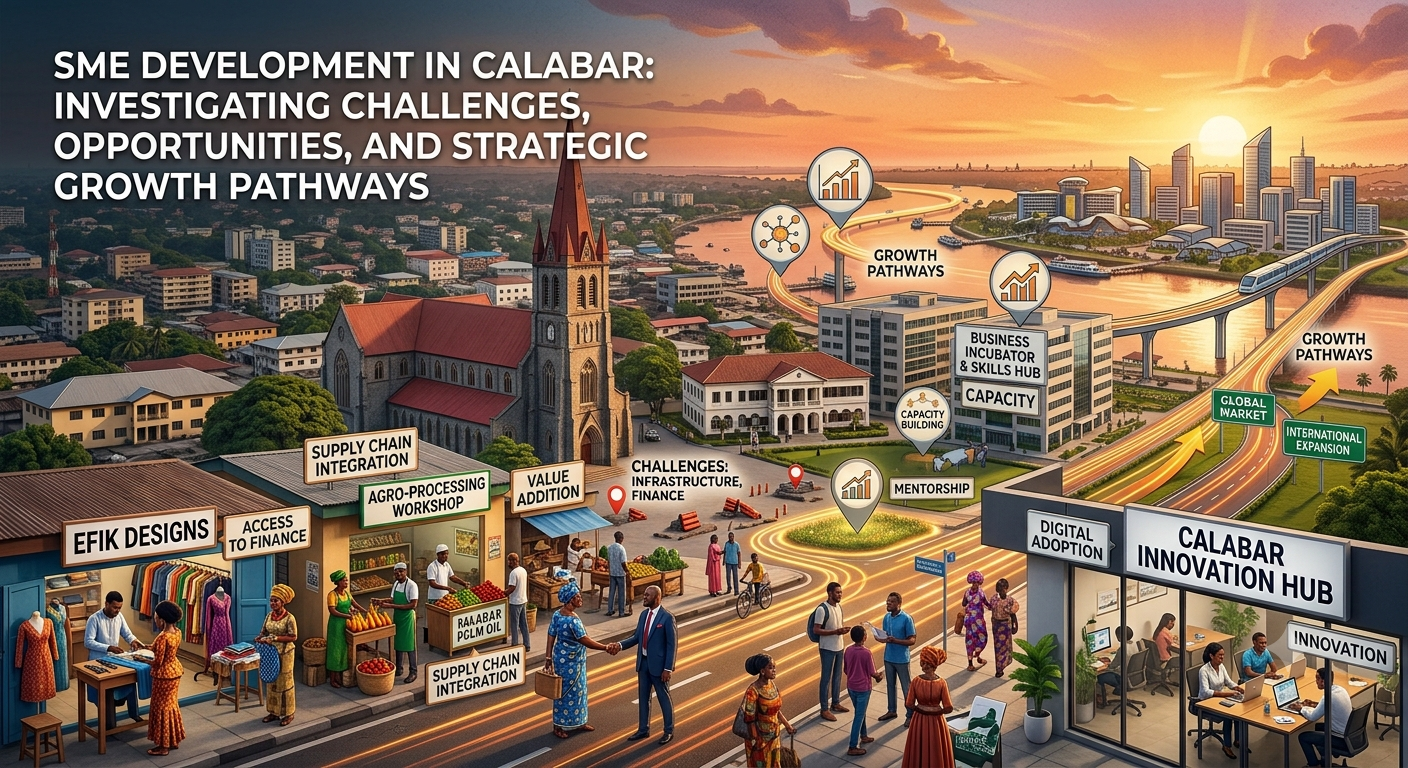
SME DEVELOPMENT IN CALABAR: INVESTIGATING CHALLENGES, OPPORTUNITIES, AND STRATEGIC GROWTH PATHWAYS

By
Esther Divine Agabaidu
ABSTRACT
Small and Medium Enterprises (SMEs) are globally recognized as engines of economic growth, employment generation, and innovation. In Nigeria, SMEs contribute nearly half of the national GDP and provide over 80% of jobs, yet they face persistent challenges that hinder their sustainability and competitiveness. This study investigates the constraints, opportunities, and strategic growth pathways for SMEs in Calabar, Cross River State. Using a descriptive survey design, data were collected from 345 SME operators across manufacturing, services, trade, and ICT sectors. Findings reveal that infrastructural deficiencies, multiple taxation, and limited access to finance are the most critical barriers to SME growth. Conversely, opportunities exist in tourism, ICT, agro processing, and cross border trade with Cameroon and the Central African Economic and Monetary Community (CEMAC). Regression analysis confirmed that infrastructure and access to finance significantly influence SME performance, while government policies play a decisive role in sustainability. The study concludes that SMEs in Calabar require integrated support through infrastructure investment, financial inclusion, entrepreneurial training, and policy reforms. Recommendations include harmonization of taxes, credit guarantee schemes, and public private partnerships to enhance innovation and competitiveness. This research contributes to SME scholarship by providing subnational evidence from Calabar and offers actionable insights for policymakers, entrepreneurs, and investors seeking to strengthen SME development in emerging economies.
Keywords: SMEs, Calabar, infrastructure, finance, entrepreneurship, policy reform, sustainability, innovation.
Download journal here!