
CUSTOMER COMPLAINT MANAGEMENT AS A STRATEGIC TOOL FOR CUSTOMER RETENTION IN SERVICE-ORIENTED BUSINESSES

By
ADEAZE AKOBUEZE PATIENCE
ABSTRACT
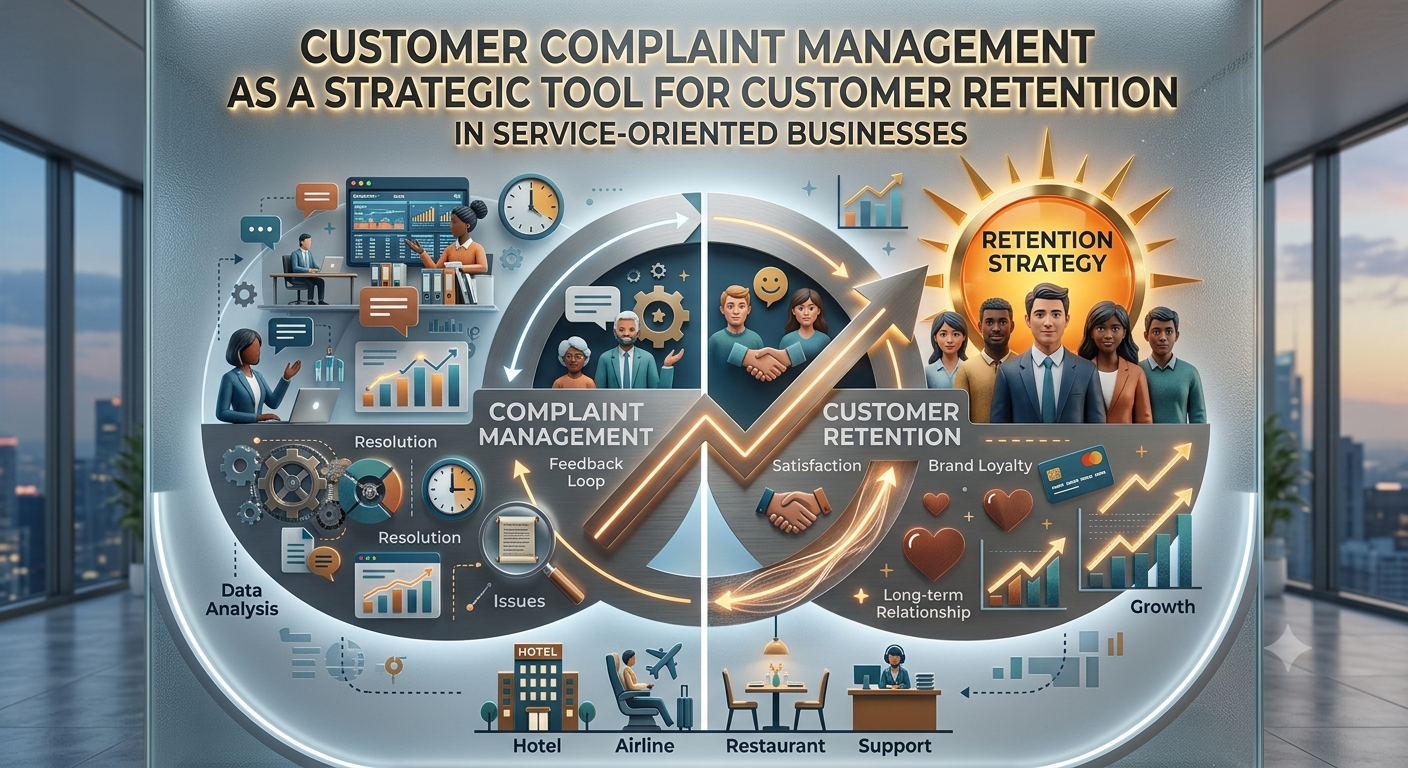
In today’s hyper competitive service environment, customer retention has become a critical driver of profitability and sustainable growth. This study positions Customer Complaint Management (CCM) not as a reactive cost center but as a strategic pillar for retention. Drawing on seminal theories of service recovery, justice theory, and relationship marketing, as well as empirical evidence from Ejibenam et al. (2021) and Wasfi & Kostenko (2014), the paper demonstrates the causal chain linking effective complaint handling to satisfaction, loyalty, and retention. Quantitative findings from the banking sector reveal that proficient complaint management explains over 40% of the variance in customer loyalty, underscoring its measurable impact on long term relationships.
The study identifies key components of strategic CCM—facilitation of complaints, distributive, procedural, and interactional justice, employee empowerment, and technology integration—and highlights barriers such as organizational silos, underinvestment in training, and cultural variations. By reframing CCM as a proactive, strategically integrated system, the paper argues that service oriented businesses can transform service failures into opportunities for deeper customer trust, advocacy, and profitability.
Beyond theoretical insights, the project provides actionable recommendations for managers, including reframing CCM as a profit center, investing in CRM technology, empowering frontline staff, and embedding complaint data into continuous improvement processes. Ultimately, the study concludes that in an era where customer experience is the ultimate differentiator, a proactive and strategically integrated complaint management system is not optional but imperative for businesses seeking sustainable growth through loyalty and trust.
Keywords: Customer Complaint Management, Customer Retention, Service Recovery, Customer Loyalty, Organizational Growth, Service Quality, Strategic Tool.
Download Journal Here!