

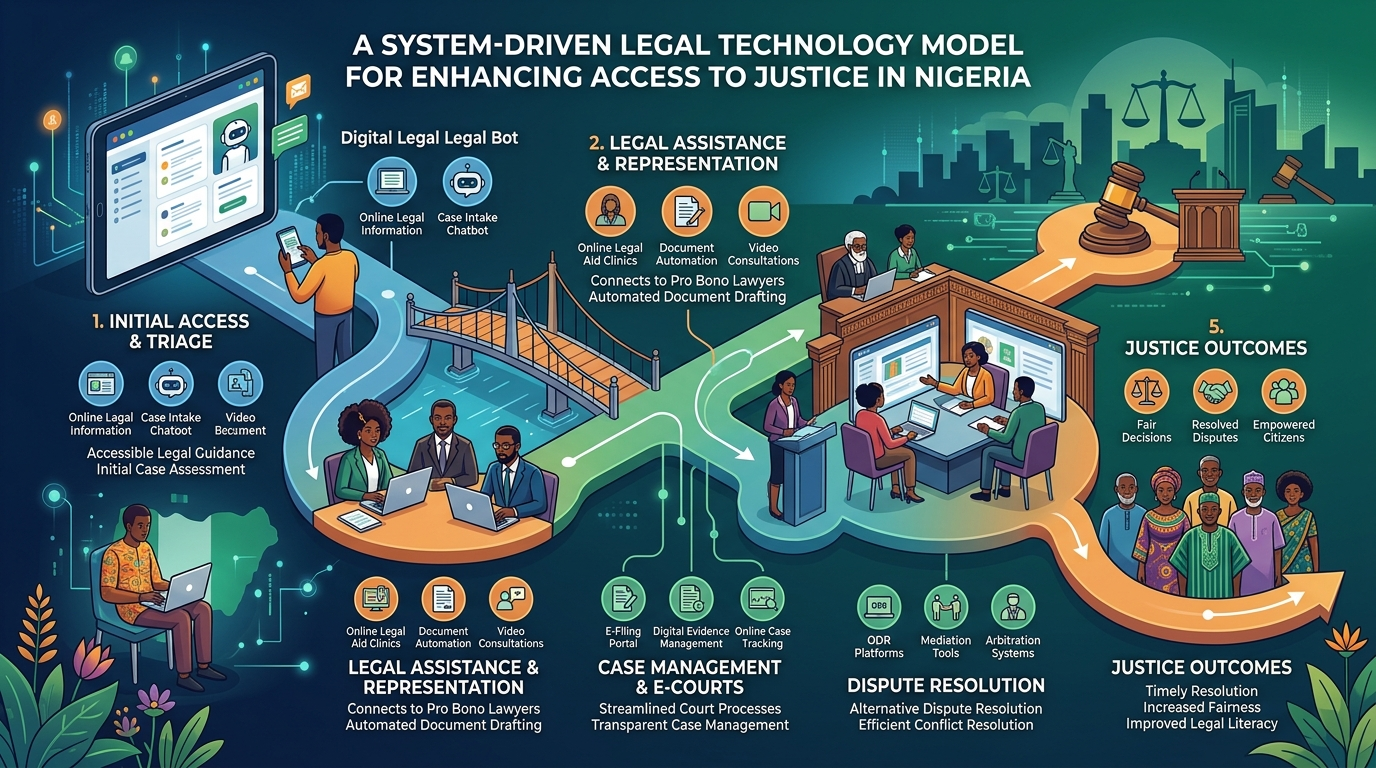
A SYSTEM-DRIVEN LEGAL TECHNOLOGY MODEL FOR ENHANCING ACCESS TO JUSTICE IN NIGERIA

BY
JOYCE CHIAMAKA IWEJUO
ABSTRACT
Access to justice remains a fundamental pillar of democratic governance and the rule of law. However, in Nigeria, persistent challenges such as procedural delays, high litigation costs, inadequate infrastructure, limited legal awareness, and institutional inefficiencies continue to restrict citizens’ access to timely and affordable justice. Although various Legal Technology (LegalTech) initiatives—including the Nigeria Case Management System (NCMS), Lagos Court Management Information System (LagosCoMiS), e-filing platforms, and digital legal information services—have been introduced to address these challenges, their impact has been constrained by fragmentation, poor interoperability, low digital literacy, and inadequate policy coordination. This study examined the potential of a system-driven legal technology framework to enhance access to justice in Nigeria.
The study adopted a qualitative exploratory research design and a model-development approach. Data were obtained through document analysis, stakeholder interviews, observations of existing digital justice platforms, and reviews of policy and institutional reports. The analysis was guided by the Technology Acceptance Model (TAM) and Diffusion of Innovation (DOI) Theory. Findings revealed that key barriers to effective LegalTech adoption include digital infrastructure deficits, institutional resistance to technological change, public trust concerns, and limited digital literacy among justice system users. The study further found that existing LegalTech initiatives demonstrate significant potential for improving transparency, reducing case backlogs, enhancing service delivery, and expanding legal aid access when supported by appropriate institutional frameworks.
Consequently, the study proposes a System-Driven Legal Technology Model (SDLTM) integrating e-filing, virtual hearings, legal aid services, and data analytics within a unified digital ecosystem. The study concludes that sustainable digital transformation of Nigeria’s justice sector requires coordinated policy support, infrastructure investment, stakeholder capacity building, and collaborative partnerships among government institutions, the judiciary, and technology innovators.
Keywords: Access to Justice, Legal Technology, Judicial Digitalization, E-Filing Systems, Digital Governance, Justice Sector Reform, Technology Acceptance Model, Diffusion of Innovation, Nigeria Judiciary, LegalTech Innovation
Download Journal Here!